
Research - Distributional patterns
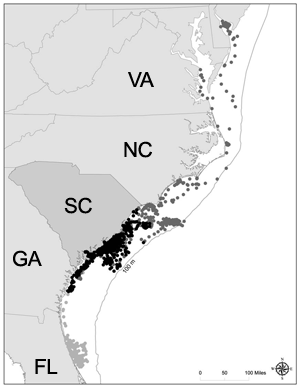 Locations where 34 juvenile loggerhead sea turtles were detected after being tagged with satellite transmitters off the coast of Charleston, SC in 2004 to 2007. Black dots denote 28 resident loggerheads, with gray dots indicating six migrant individuals. Detailed findings from this research appear in Arendt et al. (2012), Marine Biology, Volume 159(Issue 1), pages 127 to 139.
Understanding the distributional patterns of sea turtles on foraging grounds is a precursor for minimizing negative interactions; however, it is also critical to appreciate distributional patterns in order to evaluate survey sampling designs. For example, if sea turtles predominantly occurred in coastal waters off SC during migration, high catch rates could be expected during migration periods whereas low catch rates should be expected during other times of the year when few resident sea turtles were present. Similarly, if sea turtles exhibit habitat preferences, then catch rates should be greater in areas where sea turtles selectively occur compared to other areas where sea turtle occurrence may simply represent transit from one preferred habitat to another.
Analysis of capture locations reveals fine-scale spatial preferences within areas of the Charleston, SC and the Port Canaveral, SC shipping channels as well as areas of clustered catch within the regional sea turtle trawl survey area. Clustered spatial distributions19 include areas where turtles are routinely captured as well as areas where they are rarely captured. Of the 4756 trawling events completed through 2011, only four percent were associated with low capture areas. However, high capture areas (nine percent of events) accounted for 23% of all loggerhead sea turtles caught. Although the locations of clustered distributions have been successfully elucidated, the reason why these sea turtle clusters (or lack thereof) occur where they do remains a mystery. With certainty, we have determined that clusters are not affiliated with turtle size, sex or genetic haplotype nor are these clusters a reflection of habitat and supported species, water depth or distance from shore, or hydrographic conditions recorded during the trawling event.
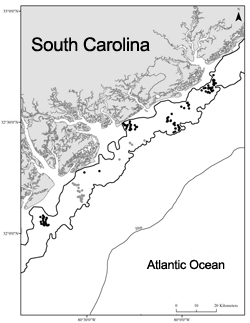 Locations of clustered sea turtle catch (black dots) or areas where sea turtles are rarely caught (gray dots) in the regional sea turtle trawl survey between Charleston, SC and Savannah, GA. Detailed findings from this analysis are currently ‘in press’ and will be published in a paper by Arendt et al. in the journal Endangered Species Research in late 2012 or early 2013.
19 Arendt, M.D., J. Boynton, J.A. Schwenter, A.L. Segars, J.I. Byrd, P.P. Maier, J.D. Whitaker, D.W. Owens, G. Blanvillain, J.M. Quattro, and M.A. Roberts. 2012. Spatial clustering of loggerhead sea turtles in the Northwest Atlantic: implications for management surveys. Endang Species Res 18:219–231.
20 Arendt, M.D., A.L. Segars, J.I. Byrd, J. Boynton, J.D. Whitaker, L. Parker, D.W. Owens, G. Blanvillain, J.M. Quattro, and M.A. Roberts. 2012. Seasonal distribution patterns of juvenile loggerhead sea turtles (Caretta caretta) following capture from a shipping channel in the Northwest Atlantic Ocean. Marine Biology 159(1):127–139.
21 Arendt, M.D., A.L. Segars, J.I. Byrd, J. Boynton, J.A. Schwenter, J.D. Whitaker, and L. Parker. 2012. Migration, distribution, and diving behavior of adult male loggerhead sea turtles (Caretta caretta) following dispersal from a major breeding aggregation in the Western North Atlantic. Marine Biology 159(1):113–125.